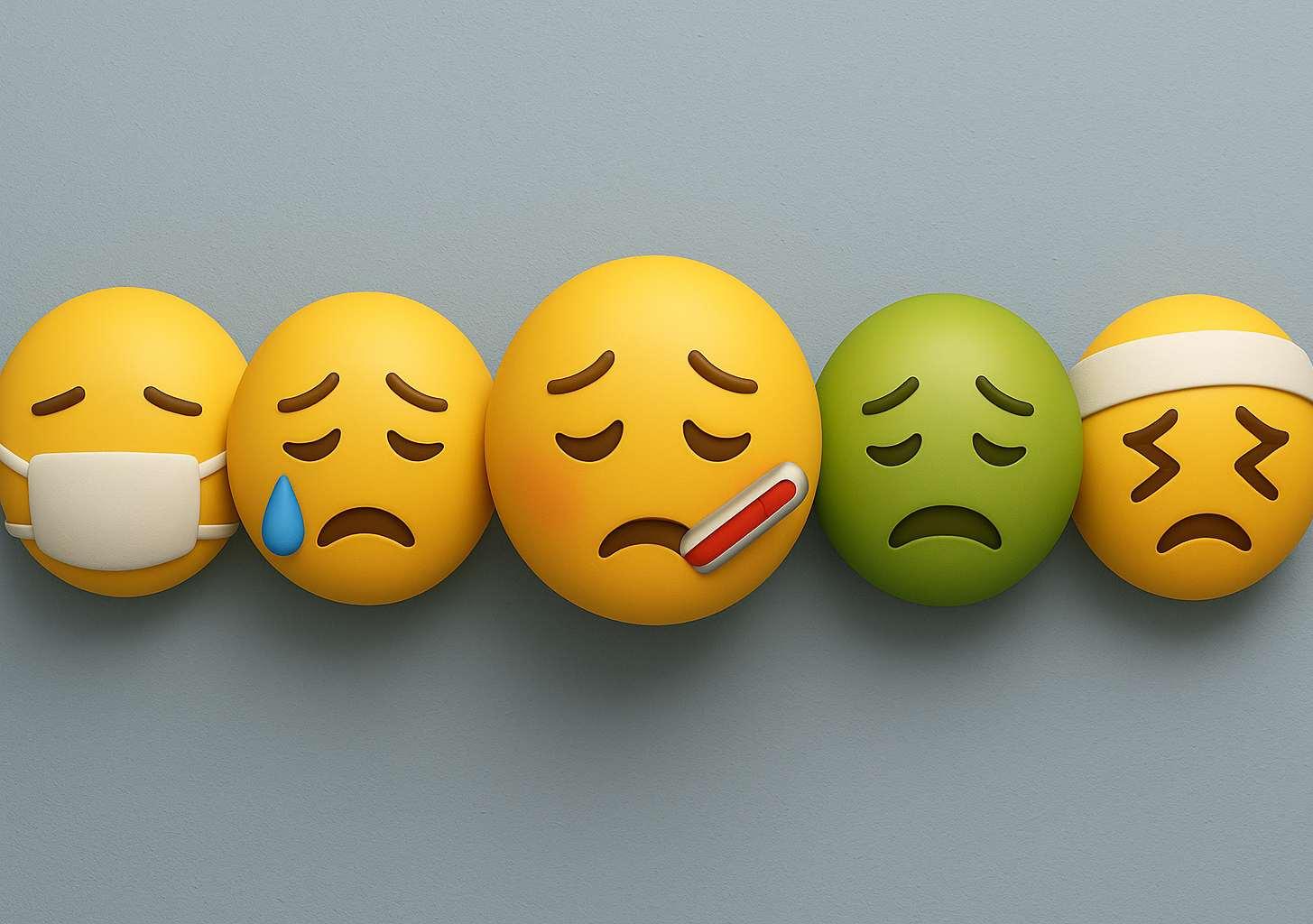
In a world where we often text instead of talk, emojis have become our emotional shorthand. From 🤒 to 😩, these tiny icons help us communicate how we feel — even when we’re too tired or sick to find the words. The sick emoji meaning has evolved far beyond a simple depiction of illness. It represents discomfort, fatigue, vulnerability, and even empathy in digital communication. When someone wonders how to express illness with emoji, they’re really asking how to make their invisible feelings visible through symbols.
Over time, emojis for when you feel sick have become part of the shared emotional vocabulary of the internet. They compress complex states — fever, nausea, burnout — into a single, instantly understood image. In doing so, they reveal how we blend humor, self-expression, and human frailty in our online lives.
Physical Illness Emojis
Digital expressions of physical illness mirror the human experience of being unwell. From sniffles to serious conditions, these icons allow people to describe discomfort quickly and universally. Here are some of the most commonly used emoji for sick and their nuanced meanings.
Emoji | Name & Context | Meaning & Usage |
|---|---|---|
🤒 | Face with Thermometer — When You’ve Caught a Cold or Fever | The 🤒 emoji meaning is clear: fever, flu, or general malaise. It shows a flushed face holding a thermometer, instantly conveying “I’m under the weather.” People use it to indicate they’re feeling physically unwell, but also metaphorically — for example, to describe “burnout fever” after long workdays. It’s an efficient way to say, “I’m not feeling great,” without elaborating. |
🤧 | Sneezing Face — For Allergies or Flu Season | The 🤧 emoji depicts a face blowing its nose, often used during cold or allergy season. It’s a visual shorthand for being congested or run-down. In chats, it appears alongside tissue or soup emojis to dramatize illness or self-pity humorously. As an emoji for flu, it captures both discomfort and a touch of comedic exaggeration — a mix typical of online illness expression. |
🤕 | Face with Head-Bandage — Injuries and Recovery | The 🤕 emoji meaning extends from literal injuries to emotional ones. While it was designed to depict someone recovering from a head wound, it’s also used metaphorically — for instance, after a tough day, a breakup, or an embarrassing mistake. It says, “I’m hurt, but I’ll survive.” In this way, the emoji bridges physical pain and emotional resilience. |
🤢 / 🤮 | Nauseated Face & Face Vomiting — Expressing Nausea or Disgust | The 🤢 emoji shows a green-tinted face on the verge of vomiting, representing nausea, motion sickness, or food poisoning. Online, it’s often used figuratively to express disgust — a reaction to bad news, an unpleasant opinion, or cringe content. The more extreme 🤮 Face Vomiting intensifies that feeling, signaling total repulsion or overwhelming sickness. Together, they’re among the most expressive emojis for when you feel sick, blending physical symptoms with emotional reactions. |
😷 | Face with Medical Mask — Protection, Illness, or Pandemic-Related Use | Before global health crises made masks ubiquitous, the 😷 emoji already represented protection and illness. Its meaning deepened as masks became symbols of responsibility, safety, and public health awareness. It can indicate someone is sick, cautious, or even participating in discussions about medical care. As a medical emoji, it embodies how our visual language adapts to real-world events. |
Emojis for Exhaustion and Burnout
Not all sickness is physical. Modern communication uses emojis to portray fatigue, stress, and mental overload. The tired emoji family reflects the collective sense of burnout in contemporary life.
Emoji | Name & Context | Meaning & Usage |
|---|---|---|
😫 | Tired Face — When Work or Life Feels Overwhelming | The 😫 emoji captures physical or emotional exhaustion. It’s often used after long workdays, sleepless nights, or overcommitment. The drooping eyes and open mouth signal fatigue and surrender. As an emoji for exhaustion, it resonates with anyone stretched too thin. |
😩 | Weary Face — Emotional Exhaustion | The 😩 emoji meaning overlaps with 😫 but leans toward emotional weariness — a kind of soulful tiredness. It appears in posts about burnout, heartbreak, or even existential fatigue. Unlike the sickly tone of 🤒, this emoji says, “I’m drained,” conveying mental collapse rather than bodily illness. |
🥴 | Woozy Face — Dizziness or Feeling Unsteady | Introduced more recently, the 🥴 emoji meaning involves dizziness, tipsiness, or disorientation. It represents physical imbalance or confusion, sometimes humorously implying overindulgence or fatigue. In the context of burnout, it can mean feeling “off,” both mentally and physically. |
Dizzy Faces — Confusion and Faintness | The dizzy-eyed 😵 emoji and its newer cousin 😵💫 (with swirling eyes) visualize confusion, vertigo, or fainting. They can describe actual dizziness or the sense of being overwhelmed by too much information, emotion, or stress. As burnout emojis, they often accompany messages about chaotic schedules or sensory overload. | |
Sweaty Faces — Anxiety, Stress, or Fever | The 😰 (anxious face with sweat) and 😓 (downcast face with sweat) show different shades of distress. They depict both physical symptoms, like fever or exertion, and emotional strain, like anxiety or worry. As tired emoji meaning examples, they blur the boundary between body and mind, representing how stress manifests physically. |
Symbolic Health Emojis
Beyond faces, the emoji keyboard includes symbolic imagery that mirrors healthcare and medicine. These icons often appear in conversations about wellness, recovery, and prevention — visual cues of care and self-maintenance. They’re the foundation of the medical emoji set.
Emoji | Name & Context | Meaning & Usage |
|---|---|---|
💊 | Pill — Medicine and Treatment | The 💊 emoji signifies medication, treatment, or self-care routines. It’s used literally for pharmaceuticals or figuratively for recovery and healing. Online, it sometimes expresses acceptance — “taking the pill” as a metaphor for reality. |
💉 | Syringe — Vaccination or Injection | The 💉 emoji often represents medical procedures, vaccinations, or health interventions. During global health events, it became a symbol of collective protection and medical advancement. As an emoji for doctor or healthcare worker, it conveys professionalism, precision, and care. |
🩹 | Bandage — Healing and Recovery | The 🩹 emoji expresses the process of healing — physical, emotional, or social. It’s frequently used to indicate minor injuries, self-care, or support for others going through tough times. Among health symbols emoji, it’s one of the most optimistic, pointing toward recovery rather than illness. |
🏥 | Hospital — Serious Illness or Medical Context | The 🏥 emoji stands for healthcare institutions, medical emergencies, or visits to treatment centers. It grounds conversations about health in a place of care and seriousness. As an emoji for hospital, it can represent both literal and symbolic healing spaces. |
🧪 | Test Tube — Lab Tests, Science, or Diagnostics | While not inherently medical, the 🧪 emoji often appears in contexts of testing, diagnostics, or scientific discovery. It adds a technical tone to health discussions — the intersection of science, innovation, and care. |
The Emotional Side of Sickness
Being sick isn’t just about physical symptoms. Online, illness emojis often stand in for emotions like exhaustion, sadness, or anxiety. When people send a 🤒 emoji, they’re not always talking about a fever. Sometimes, it means, “I’m overwhelmed,” “I’m tired of everything,” or “I need rest.”
The emotional use of illness imagery reflects how digital communication merges the physical and mental. A 😩 emoji meaning of burnout can be paired with a 😷 emoji to convey feeling “emotionally contagious” — spreading negativity or fatigue. Similarly, the emoji for mental health discourse has expanded to include physical illness icons as symbols of emotional states.
The language of sickness online provides a safe, even humorous, way to talk about vulnerability. Instead of directly saying “I’m struggling,” users might share a combination of 🤕 and 😩 — shorthand for both pain and perseverance. This practice allows people to express emotional exhaustion emoji sentiments while maintaining a sense of levity or relatability.
In this sense, emojis become emotional tools rather than mere decorations. They help people disclose distress, ask for empathy, or acknowledge shared burnout — without explicitly stating it.
Cultural and Social Context
The meanings of sick emojis aren’t static; they shift across cultures, languages, and online communities. In some regions, 😷 remains closely tied to public health awareness and hygiene. In others, it’s become a symbol of politeness or self-restraint — wearing a mask to avoid spreading germs or emotions.
In many online spaces, especially on social media, illness emojis are used playfully. The 🤢 emoji might accompany a joke about bad food or a “cringe” moment. The 🤒 emoji can express sympathy — “feel better soon!” — or exaggerated drama — “I’m so tired I might die.” This humorous reinterpretation softens the seriousness of sickness while maintaining its expressive power.
Cultural nuance also affects how health emojis appear in digital empathy. In Western contexts, a message combining 🩹 and 💊 might imply care and encouragement. In East Asian cultures, the 😷 emoji can signal civic responsibility or consideration for others. Even generational differences shape interpretation: younger users may employ 🧪 or 🤕 in ironic or aesthetic ways, blending humor with the language of wellness.
Across all these uses, emojis for illness and exhaustion function as emotional punctuation — bridging gaps between empathy, humor, and realism. They turn discomfort into connection, and through that, they humanize digital conversation.
Conclusion
The evolution of the sick emoji mirrors how we express vulnerability in the digital age. Whether it’s a 🤒 emoji meaning literal fever or figurative fatigue, each icon captures a small truth about being human. They let us show pain, weakness, and recovery in an online world that often prizes composure and speed.
Through faces, symbols, and shared humor, we’ve built a visual language of illness and exhaustion — one that speaks to both the body and the mind. These health emojis remind us that behind every glowing screen is a person who sometimes feels tired, dizzy, anxious, or simply done for the day.
In transforming our symptoms into symbols, we haven’t just digitized discomfort — we’ve made it communal.