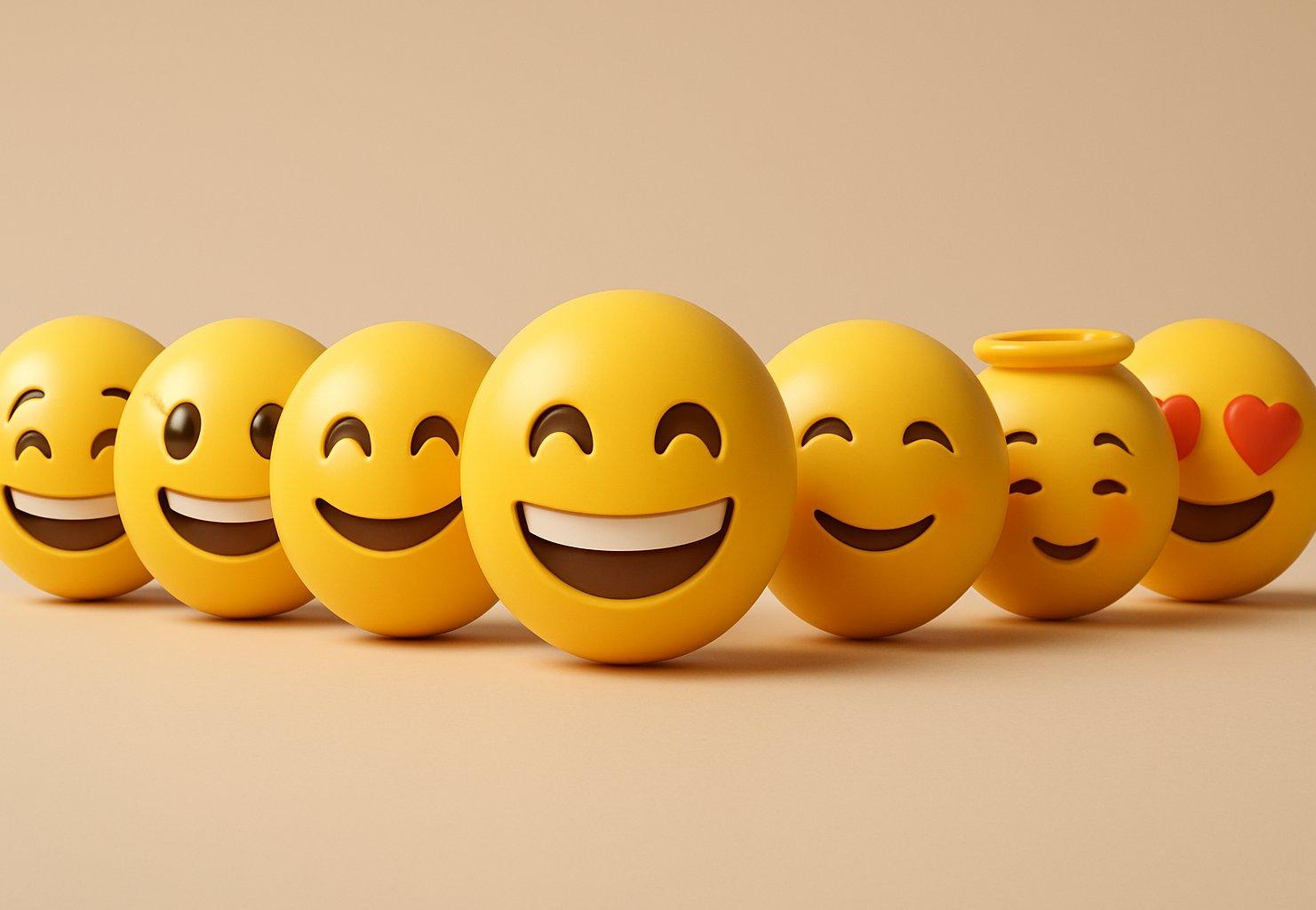
In digital communication, few symbols are as instantly recognizable as the happy face emoji. From casual chats to professional messages, this small yellow icon has become a universal shorthand for positive emotion — expressing warmth, gratitude, humor, and empathy across languages.
The happy face emoji is more than decoration; it’s an emotional signal that restores tone and expression to text stripped of voice and gesture. It bridges the gap between written words and human feeling, helping messages sound friendly and clear.
Its popularity is immense — smiling emojis make up a major share of global emoji use. They smooth interactions, prevent misunderstanding, and add friendliness to digital exchanges. To understand its dominance, one must explore its origins, evolution, and the emotional nuances within its many variations.
History and Evolution of Smileys
The lineage of the happy face emoji can be traced back to simple textual and graphic experiments with emotion.
From Emoticons to Emoji
Before graphical emoji existed, users relied on emoticons — the arrangement of punctuation to form sideways faces, such as :-) or :). Emerging in early computer networks and bulletin boards, these tiny constructions gave early digital communicators a way to hint at tone or mood. They were pragmatic inventions: concise, universal, and independent of font or color.
Parallel to this Western “sideways” style, Japanese internet users developed kaomoji — upright facial expressions built from local characters like (^_^) or (>‿<). Kaomoji were expressive, detailed, and capable of showing a range of feelings well beyond happiness.
The Graphic Smiley
At roughly the same time, in popular culture, the graphic “smiley face” — a bright yellow circle with two dots for eyes and an upward curve for a mouth — became emblematic of optimism and simplicity. It appeared on posters, pins, and advertising, reinforcing the notion that a smiling face could communicate positivity instantly and wordlessly.
Standardization of Emoji
When mobile technology advanced to support small color pictograms, designers began including expressive faces. Over time, these images were standardized through the Unicode Consortium, allowing them to appear consistently across devices. The “grinning face,” “smiling face with smiling eyes,” and other variants entered this system, each assigned a unique code point.
The happy face emoji family grew rapidly as users demanded more nuance: not all smiles express the same thing. A grin of relief, a bashful smile, a laugh of hysteria, or a fond smile of affection each needed a separate visual form. Thus emerged the richly diversified catalogue of smiling faces we use today.
Types of Happy Face Emoji
This section, the heart of the article, explores the many faces of happiness in the emoji universe. Although they all share the basic premise — a curved mouth and expressive eyes — their subtleties reveal the complexity of human emotional signaling.
Below, the main types are organized into three large groups: Basic Happy Faces, Cute or Affectionate Happy Faces, and Other Joyful or Playful Happy Emojis. Each is described in detail, with emphasis on its emotional undertone and how it differs from closely related forms.
Basic Happy Faces
Emoji | Name | Description |
|---|---|---|
Grinning Face | The simplest symbol of joy — open eyes and broad smile expressing general happiness, enthusiasm, or satisfaction; friendly but neutral in tone. | |
Grinning Face with Big Eyes | A livelier grin with widened eyes showing excitement or delight; suits cheerful greetings or good news. | |
Grinning Face with Smiling Eyes | A beaming expression with crescent eyes suggesting genuine, heartfelt joy; conveys warmth and amusement. | |
Smiling Face with Smiling Eyes | Soft, gentle smile showing calm happiness, gratitude, or affection; often used to express kindness or sincerity. | |
Slightly Smiling Face | Mild and polite smile; can imply friendliness, restraint, or subtle irony depending on context; cooler than 😊. | |
Beaming Face with Smiling Eyes | Wide, toothy grin with closed eyes showing excitement or pride; used to celebrate success or shared joy. | |
Grinning Squinting Face | Intense, closed-eye laughter — pure, unrestrained amusement without exaggeration. | |
Grinning Face with Sweat | Mix of relief and humor; a grin paired with a sweat drop suggests “that was close” or modest embarrassment. | |
Smiling Face with Halo | Calm, angelic smile beneath a halo; conveys innocence, virtue, or playful mock purity depending on tone. |
Laughing and Extreme Joy Faces
Emoji | Name | Description |
|---|---|---|
Face with Tears of Joy | The iconic laughing emoji — head tilted, eyes shut, tears streaming. Expresses overwhelming amusement or hilarity; often used to mark humor, sometimes ironically for awkward situations. | |
Rolling on the Floor Laughing | A more animated version of 😂, tilted further as if in motion. Conveys uncontrollable, exaggerated laughter; commonly used repeatedly to emphasize how funny something is. |
Together, 😂 and 🤣 symbolize the peak of digital humor — laughter rendered visible.
Cute or Affectionate Happy Faces
Emoji | Name | Description |
|---|---|---|
Smiling Face with Heart-Eyes | Radiates admiration and affection; heart-shaped eyes show love or deep delight toward someone or something; warm and romantic in tone. | |
Kissing Face with Closed Eyes | Gentle, affectionate expression with puckered lips and closed eyes; suggests tenderness or a friendly peck. | |
Kissing Face with Smiling Eyes | A brighter, playful kiss; smiling eyes add charm and lighthearted affection, balancing friendliness and romance. | |
Face Savoring Food | Tongue to the side in gleeful delight; represents enjoyment of food or any pleasant indulgence; playful and satisfied. | |
Winking Face with Tongue | Mischievous wink and tongue out; conveys teasing humor, silliness, or irony — ensures a joke is taken lightly. | |
Squinting Face with Tongue | Exaggerated version of 😜 with eyes shut tight; expresses carefree fun, goofiness, or spontaneous laughter. |
Other Joyful or Playful Happy Emojis
Emoji | Name | Description |
|---|---|---|
Smiling Face with Open Hands | The “hugging face”; open hands suggest offering warmth, comfort, or gratitude — expresses empathy and support beyond a simple smile. | |
Star-Struck | Eyes as glowing stars and mouth agape; shows amazement, admiration, or being dazzled by something impressive or inspiring. | |
Smiling Face with Hearts | Gentle smile surrounded by hearts; softer and more caring than 😍, symbolizing affection, warmth, and emotional closeness. | |
Partying Face | Wearing a party hat with confetti; pure celebration in emoji form — used for birthdays, achievements, or joyful occasions. | |
Smiling Cat Face with Open Mouth | A playful cat version of a grin; conveys cheerful humor or irony with a cute, whimsical twist. | |
Grinning Cat Face with Smiling Eyes | Feline variant of 😄; cheerful and mischievous, often used for lighthearted or eccentric expressions of joy. |
The Spectrum of Digital Happiness
Across these twenty-plus variations, the happy face emoji captures nearly the full emotional range of positive affect — from subdued politeness to ecstatic laughter. Their coexistence underscores how digital communication seeks precision in emotion: humans rarely feel “just happy.”
A crucial point lies in the micro-differences:
The curvature of the eyes distinguishes genuine delight (😊, 😄) from polite formality (🙂).
The presence of tears (😂) turns joy into hilarity.
Added symbols like halos (😇) or hearts (😍, 🥰) expand the context from mood to moral or relational tone.
Motion and props — confetti, stars, sweat — transform emotional energy into narrative.
By selecting one over another, users craft subtle distinctions: contentment versus excitement, affection versus admiration, humor versus sincerity. The multiplicity of happy faces is therefore not redundancy but richness — a vocabulary of smiles that reflects the layered texture of human emotion.
Usage in Different Contexts
The happy face emoji family functions as a flexible grammar of emotion across diverse communicative contexts. Its power lies not only in what it shows but in how it modulates tone. A simple sentence — “Thanks.” — can sound curt in plain text. Add 😊 and it becomes warmly sincere; add 😅 and it conveys modest relief; add 😂 and it turns humorous.
In Personal Communication
In informal exchanges, happy face emojis often appear as markers of camaraderie and social connection. Friends use them to signal understanding, amusement, or encouragement. A laughing emoji can soften teasing, while a smiling one underscores empathy. Even brief replies gain emotional weight when accompanied by these symbols.
Emojis also serve as response substitutes — stand-alone acknowledgments that replace verbal messages. A single 😊 might mean “I’m happy for you,” “That’s nice,” or simply “I saw this.” The economy of expression allows users to maintain interaction without elaboration.
In Romantic and Intimate Messaging
Happy faces transform dramatically in romantic discourse. Here, subtle differences matter: 😍 or 🥰 imply affection or admiration; 😚 expresses tenderness; 😜 hints at playful flirtation. The right choice shapes the emotional temperature of the conversation. Their charm lies in ambiguity — balancing genuine warmth with playful restraint.
In Professional and Formal Exchanges
Even in workplace communication, smiling emojis have found cautious acceptance. A strategically placed 🙂 or 😊 can temper directness, communicate friendliness, or close a message politely. They humanize digital correspondence without undermining professionalism — when used sparingly.
On Social Media
Across platforms, happy faces serve as shorthand for participation and alignment. Comment sections filled with 😂 or 😍 signal community consensus — shared laughter, admiration, or joy. The emoji thus becomes a collective reaction mechanism, uniting strangers through common feeling.
In Marketing and Branding
Though we avoid brand examples here, the principle remains: happy faces have become tools of emotional engagement. They project positivity, encourage trust, and make messages appear conversational rather than corporate. The smiling face acts as a visual handshake — an invitation to connect on emotional terms.
Cultural Differences and Perception
Despite their apparent universality, happy face emojis are not interpreted identically worldwide. Cultural psychology shapes how people read and use them.
Expression Norms
In some societies, overt expression of joy is encouraged; in others, subtlety and restraint are valued. The same 🙂 may seem perfectly cheerful in one culture but insincere or distant in another. Research in intercultural communication suggests that Eastern users, for instance, often focus more on eye expression (preferring 😊 or ^_^) than on mouth shape, whereas Western users emphasize the mouth’s curvature as the key sign of emotion.
Formality and Politeness
In cultures with strong social hierarchies, smiling emojis can signify respect rather than happiness. A polite smile — conveyed through 🙂 — may be used to acknowledge authority or maintain harmony. In more informal societies, the same symbol functions casually, expressing friendliness among equals.
Misunderstandings
Cross-cultural misreading is common. A sender using 🙂 might intend warmth; a receiver might read it as indifference. Similarly, 😂 may be perceived as mocking if used in serious contexts. These discrepancies illustrate how even standardized icons require cultural literacy to interpret correctly.
Digital Dialects
Regional variations have also emerged. In some languages, cat-face emojis 😺 or 😸 gained popularity as cute, comic substitutes for human faces. Elsewhere, the preference leans toward minimalist symbols or kaomoji. Over time, these habits form what linguists call emoji dialects — cultural styles of emotional expression embedded within global digital communication.
The Psychology of Smiling in Digital Communication
Why are humans compelled to add smiling faces to text? The answer lies in the fundamental social function of the smile itself.
Nonverbal Substitution
Smiling is a primal social cue — a gesture of safety, approachability, and shared understanding. In face-to-face interaction, it regulates conversation and conveys emotional feedback. Digital communication strips these cues away, leaving words that can easily feel cold or ambiguous. The happy face emoji reintroduces the missing signal, functioning as a paralinguistic device: a symbol that modulates tone.
Emotional Resonance
Studies in digital psychology indicate that emoji use triggers emotional mirroring. Seeing a smiling face, even in stylized form, activates neural responses similar to those involved in perceiving a real smile. This phenomenon — sometimes called emotional contagion — explains why text containing emojis often feels warmer or more human.
Social Bonding and Affiliation
Happy faces strengthen interpersonal bonds. They reduce perceived distance between communicators and increase empathy. When used appropriately, they enhance relational satisfaction in digital environments, serving the same social purpose as laughter or small talk in physical conversation.
Cognitive Efficiency
There is also a practical reason: emojis compress complex affective information into a single visual unit. Instead of describing one’s feeling, the sender can simply choose an icon. The receiver instantly decodes it, bypassing lengthy verbal explanation. This efficiency sustains the rapid tempo of modern digital discourse.
Popular Happy Face Emojis (Statistics and Trends)
Recent analyses of global emoji usage confirm that smiling and laughing faces consistently dominate frequency charts. Across messaging platforms, the 😂 Face with Tears of Joy remains among the top symbols worldwide, reflecting humor’s central role in online expression.
Closely following are 😍 Smiling Face with Heart-Eyes, 😊 Smiling Face with Smiling Eyes, and 🥰 Smiling Face with Hearts. Each embodies warmth, affection, and emotional positivity. These data suggest that digital environments — often criticized for hostility — still revolve around expressions of connection and amusement.
Generational Differences
Younger users tend to favor more exaggerated or ironic forms, such as 🤣 or 😝, while older demographics prefer the gentle neutrality of 🙂 or 😊. This reflects differences in communication style: exuberance versus composure. The diversity of smiling emojis allows each group to signal belonging to its digital subculture.
Trends Over Time
While the early 2010s saw dominance of 😂 as the default laughter symbol, later years introduced more variety. Users began selecting 🥰, 🤗, or 😇 to convey empathy and wholesomeness — a shift toward softer emotional tones. In recent years, expressive moderation has become fashionable: minimalist smiles replacing loud laughter in favor of sincerity.
Contextual Evolution
The meaning of certain happy faces evolves with social trends. For example, 🙂 has occasionally been reinterpreted as passive-aggressive or ironic in some communities — a reminder that digital symbols are dynamic, not fixed. The continued adaptation of happy faces reflects the living nature of visual language online.
Happy Face Emoji in Art and Pop Culture
Beyond casual conversation, the happy face has become an aesthetic and cultural icon.
Visual Symbolism
Its circular form and radiant color carry immediate emotional charge. Artists and designers adopt it as shorthand for optimism, irony, or social commentary. A smiling face can represent authentic joy or, conversely, critique forced positivity. Its ambiguity makes it a powerful cultural motif.
Digital Aesthetics
In graphic design and digital art, happy face emojis symbolize the collision of sincerity and simulation — a reflection on how real emotion coexists with artificial representation. The emoji smile, frozen and uniform, can simultaneously comfort and unsettle: it is both human and machine-generated.
Fashion and Visual Media
The smiling face recurs in visual culture — on apparel, installations, and digital performances — as a modern emblem of emotional shorthand. It captures the spirit of networked humanity: constant connection, instant reaction, and mediated feeling.
Social Commentary
Cultural critics often point out that the ubiquity of the happy face reveals both our desire for positivity and our anxiety about authenticity. The compulsory smile — now digitized — mirrors the pressures of perpetual good mood in online life. Artists exploit this tension, using the emoji as a lens to examine emotional labor in the digital age.
Conclusion
The happy face emoji family, in all its permutations, has become more than a digital accessory; it is a linguistic revolution in miniature. These icons extend the boundaries of written language, allowing humans to communicate affective nuance that words alone cannot carry.
Their evolution from simple text emoticons to a rich system of expressive images mirrors the trajectory of digital culture itself — from minimalism to emotional saturation. The smiling face remains at the center of this transformation because it encapsulates what communication ultimately seeks: connection.
In an era defined by speed and distance, the happy face emoji restores something deeply human — the trace of empathy behind the screen. Whether polite 🙂, radiant 😄, adoring 🥰, or laughing 😂, each smile is a small act of understanding between minds linked by pixels.
As our visual language continues to expand, new variants will inevitably appear, shaped by changing values and aesthetics. Yet the fundamental principle will remain unchanged: the need to express joy, reassurance, and belonging through a symbol that everyone, everywhere, immediately understands.