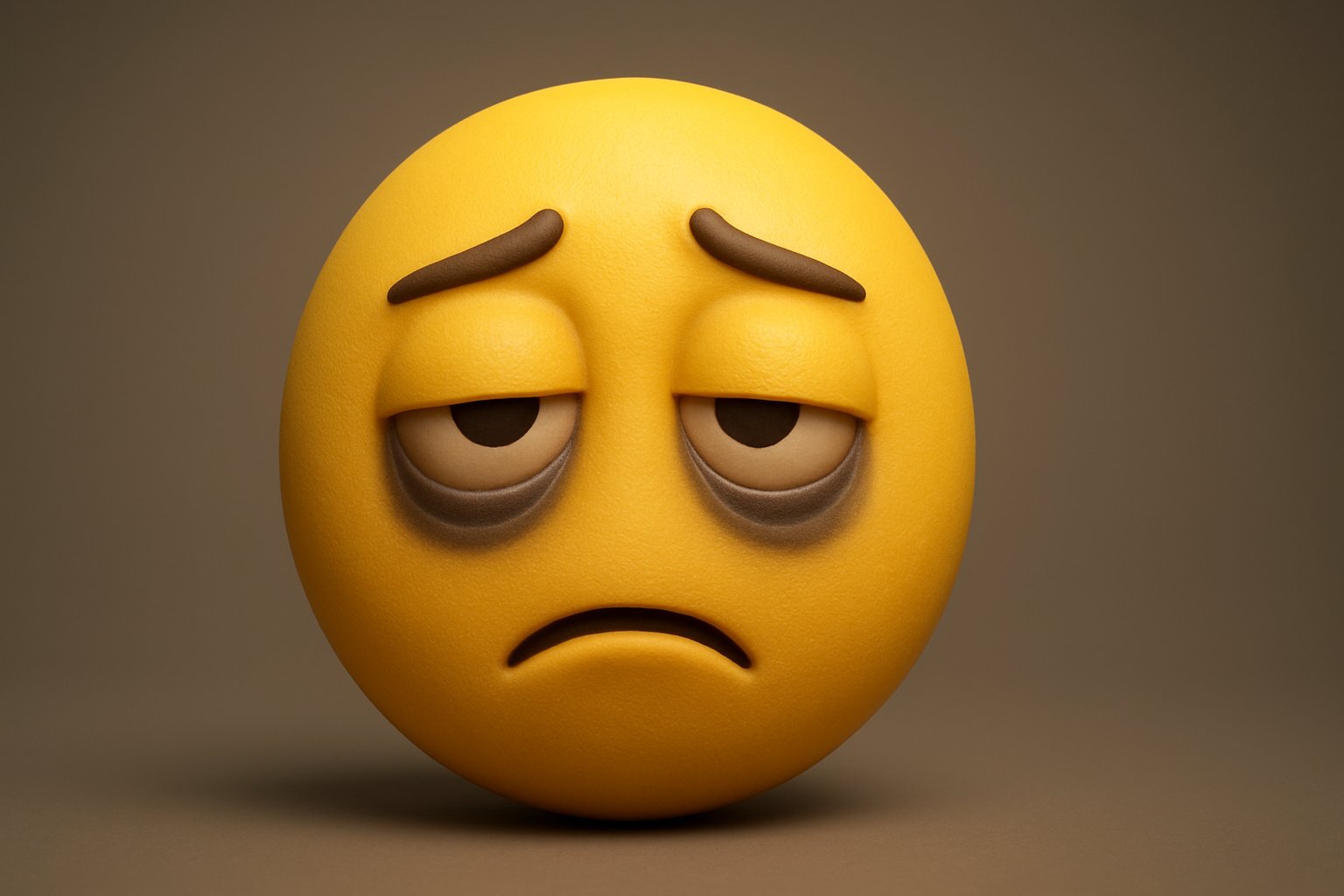
In the digital age, where most of our communication takes place through screens, emojis have become a new form of nonverbal expression. These small pictograms convey what once required tone, gesture, or facial expression. Among the vast variety of symbols, the emoji face with bags under eyes holds a special place — a figure that combines weary humanity and the bittersweet self-irony of modern life. It represents not just physical exhaustion but an entire era where overwork, sleeplessness, and emotional burnout have become almost normal.
The fascination with this symbol keeps growing because it carries more meaning than a simple joke or grimace. It’s a visual confession that a human being is not a machine — that emotional and physical energy has limits. For this reason, the “face with bags under eyes” has become a kind of mirror image of a society that values productivity more than peace, where sleepless nights are worn almost like a badge of honor. 🕓
Origins and Visual Features
The face with bags under eyes 😩 appeared later in emoji history — an evolutionary step beyond the “tired” or “sad” expressions. Its defining feature is the dark semicircles under the eyes, giving it a worn-out, drained look. Depending on the platform, the visual details may vary: sometimes it appears almost tragic, sometimes grotesque or even comic. Yet across all versions, one motif remains consistent — the physical and emotional fatigue that cannot be hidden.
This emoji stands out from other “sad” faces because it doesn’t simply express sorrow or disappointment. Instead, it hints at exhaustion that lasts longer than a fleeting emotion. It depicts a state, not a reaction. While a regular sad face might represent a temporary feeling, the face with bags under eyes symbolizes chronic fatigue — the result of sleepless nights, endless work, and accumulated stress. 😪
Meaning and Interpretations
The meaning of this emoji is layered. On the surface, it’s simple: “I’m tired,” “I didn’t sleep,” “I’m exhausted.” But in real conversations, it often carries subtler undertones. People use it to gently complain without dramatizing — a quiet “I’m tired but holding on.”
In humorous contexts, it conveys ironic acceptance of one’s condition: “Yes, I’m working late again — nothing new.” It becomes a mark of self-awareness, even pride — as if to say, “I’m still fighting, even when I’m drained.” In many ways, it unites a generation living between deadlines and chronic sleep deprivation.
Interpretations vary depending on context. In friendly chats, it’s mild fatigue after a long day. At work, it signals overload: “I’m drowning in tasks.” In memes, however, it becomes an almost philosophical symbol of the times — an ironic comment on a life where tiredness has become a universal language.
Often it appears alongside other emojis — coffee cups ☕, clocks ⏰, or yawning faces — forming short but expressive statements that communicate emotional states better than words ever could.
Everyday and Social Media Use
In everyday communication, the emoji face with bags under eyes shows up wherever fatigue, sleeplessness, overload, or quiet despair are being discussed. Students use it after all-nighters before exams. Workers send it after another marathon day. Parents include it after a night spent awake with a restless child.
It’s also become popular in public posts and stories, where people document their “real state” without filters or pretenses. This reflects a broader shift — from showing only success to acknowledging the exhaustion that often accompanies it. Such openness breaks barriers in communication and builds a sense of shared experience — a quiet community of people who understand each other without words.
Common phrases paired with this emoji often carry humor or self-irony: “Running on coffee,” “Another sleepless night,” “Surviving, not thriving.” When combined with hearts or smiles, it creates a paradoxical blend — someone who’s exhausted yet embraces their state with warmth and acceptance.
Psychological and Cultural Context
From a psychological point of view, the popularity of this emoji is tied to its reflection of a broader emotional truth: it doesn’t depict a momentary feeling but a typical condition of modern life. We live in a world of constant stimulation — messages, deadlines, expectations, and demands. The emoji with bags under eyes has become the icon of this weary modernity.
Culturally, it represents a new kind of honesty. A few years ago, social media largely celebrated “perfect lives.” Now, more people talk openly about fatigue, burnout, and the need for rest. Using this emoji is a way to say visually, “It’s hard, but I’m not alone.”
It can even be seen as a subtle protest against unrealistic standards of productivity. In a society where lack of sleep is sometimes framed as dedication, this emoji becomes the emblem of the tired yet honest person — someone who doesn’t hide their exhaustion. That’s not weakness; it’s authenticity.
Artistically, it connects with the “aesthetics of exhaustion” — visual motifs that romanticize tiredness, sleeplessness, and emotional fragility. Artists, photographers, and illustrators often use the shadowed-eye motif to express vulnerability or burnout as an integral part of the human condition. 🎭
Meme Culture and Visual Parodies
Within internet culture, the emoji with bags under eyes has long evolved into a meme. It’s often exaggerated — eyes barely open, dark circles turned into “badges of survival.” Meme creators use it to mock the everyday reality of constant tiredness: “Monday in two pixels,” “My face after three deadlines,” “Me after only one coffee.”
Over time, it has moved beyond screens. It appears in art projects, graffiti, stickers, and visual jokes — from clothing prints to digital art. This shows how deeply the symbol has embedded itself in collective consciousness.
In fan art and parodies, it takes on many forms: from realistic portraits of weary faces to heroic renditions that treat fatigue like a medal. This duality makes it perfect for a culture built on humor and self-irony.
Online, there’s even an entire layer of memes portraying this emoji as the face of a generation — the “generation that never sleeps.” These images capture a mix of laughter and despair, turning fatigue into a shared identity. Beneath the humor lies a sincere emotional core: a collective exhaustion that defines much of modern life.
Conclusion
The emoji face with bags under eyes is far more than a small digital picture — it’s a cultural symbol that unites humor and vulnerability, fatigue and resilience, self-irony and truth about modern existence. Its rise in popularity marks a shift in communication culture — from polished perfection to honest realism.
It mirrors a social reality where most people feel a lack of time, energy, and emotional balance. Even in a world obsessed with perfection, this emoji reminds us that being tired means being human.
Will it lose its relevance? Unlikely anytime soon. As long as life remains fast and expectations remain high, this emoji will stay an emblem of our age. Over time, its design may change, but its essence — the quiet honesty of exhaustion — will endure.
Ultimately, the “face with bags under eyes” is not just about tiredness 😴 — it’s about humanity in a world that often forgets what that truly means.